The CS3-SCA Programme

 Professional-grade content         

Module Structure

Module 0
The Reasoning Standard
Establishes the analytical foundation for professional judgement in Scope 3 assurance, distinguishing reasoned analysis from rule-following and introducing the defensibility standard that governs all subsequent content.
Module 1
Boundary Logic;
Direct, Indirect & Value Chain Develops rigorous understanding of organisational and operational boundaries as they apply to Scope 3 emissions. Addresses the judgement required when boundary definitions are contested or unclear.
Module 2
Category Architecture; 
Beyond Keyword Classification Addresses the 15 Scope 3 categories as analytical constructs requiring interpretation, not mechanical classification. Develops capability to navigate category boundary disputes and allocation challenges.
Module 3
Evidence Hierarchy;
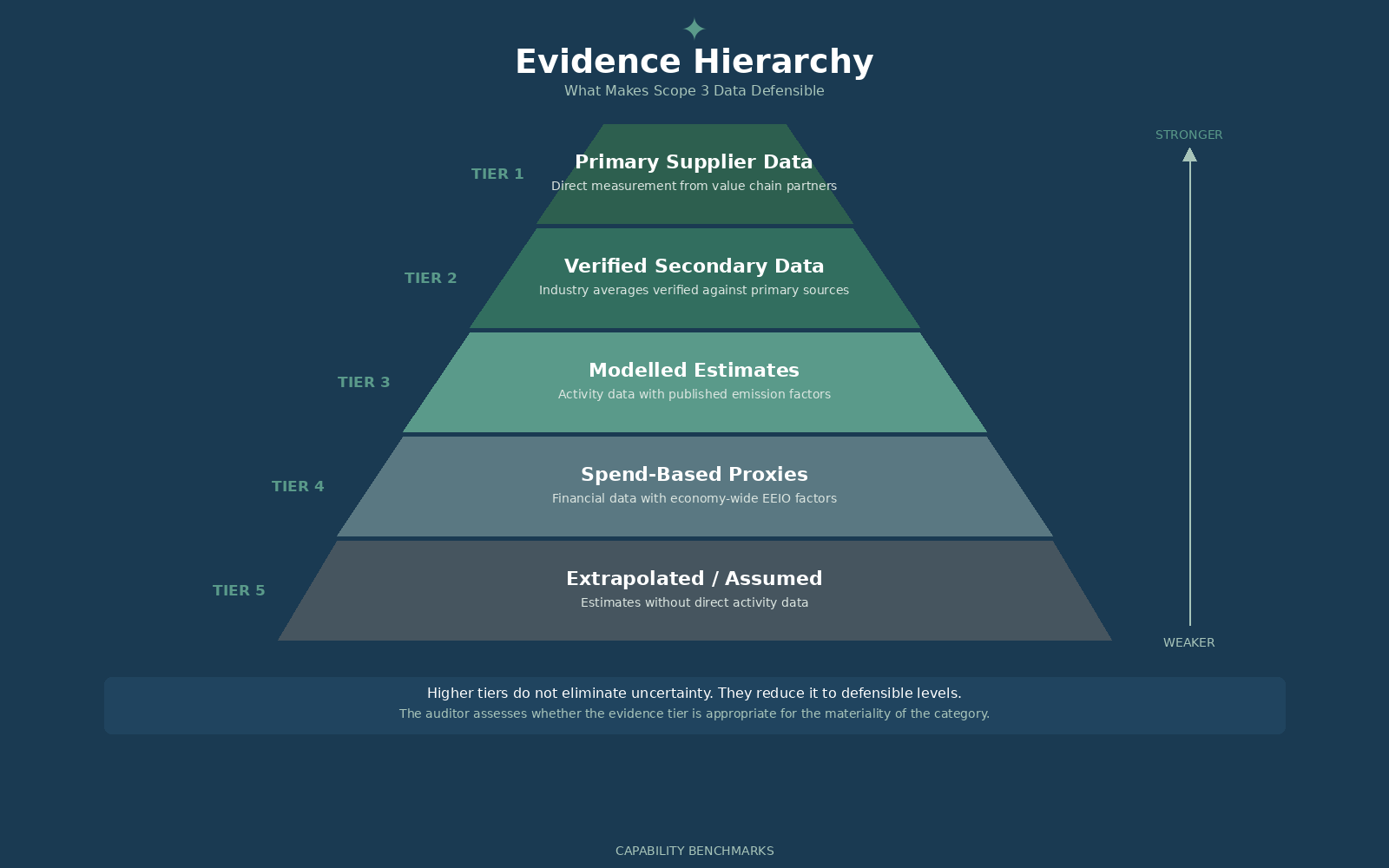
What Makes Data Defensible Establishes the framework for evaluating evidence quality in Scope 3 contexts, distinguishing between evidence tiers and developing judgement about when evidence is sufficient to support conclusions.
Module 4
Completeness & the Estimation Imperative —  
Addresses the unique completeness challenges in Scope 3 reporting, where comprehensive measurement is rarely possible and estimation is not a fallback but a professional obligation.
Module 5
Materiality & Quantitative Thresholds Are Not Enough —
Develops dual-dimension materiality assessment integrating quantitative contribution with qualitative significance, addressing the insufficiency of percentage thresholds alone.
Module 6
Year-on-Year Changes & Performance vs Methodology —
Develops analytical scepticism toward reported emissions trends, building capability to disaggregate genuine performance changes from measurement artefacts.
Module 7
Assurance Conclusions Under Imperfect Conditions —
Addresses the path from identified findings to appropriate conclusion type, developing judgement about when issues require qualification, adverse conclusion, disclaimer, or withdrawal.
Module 8
Independence & Commercial Pressure —  
Develops recognition of and resilience against independence threats in Scope 3 contexts, including self-review, familiarity, and intimidation threats that operate throughout such technical work.
Module 9
Regulatory Defence & Explaining Your Work —  
Develops documentation and explanation capabilities that withstand regulatory inspection, building capability to create coexisting records that demonstrate reasoning rather than merely conclusions.
Module 10
Integration & Reasoning Across Domains —  
Synthesises capabilities from all preceding modules into integrated professional judgement, developing ability to navigate challenges that span multiple domains simultaneously.

Programme philosophy

Reasoning... Not Compliance.

The CS3-SCA programme is not designed to teach procedural compliance with standards. It develops the professional judgement required to apply standards under uncertainty, incomplete information and contested assumptions. Every module addresses a domain where practitioners must exercise judgement rather than follow prescribed steps.


The programme content reflects the reality that Scope 3 assurance boundaries are debatable, evidence is imperfect, and conclusions must be defensible under challenge.


The instructional approach is declarative and examiner-grade. Content is presented as professional reference material, not simplified training. Practitioners are expected to engage with complexity and ambiguity rather than rely on simplified rules or checklists.
Delivery format

Delivery and Access

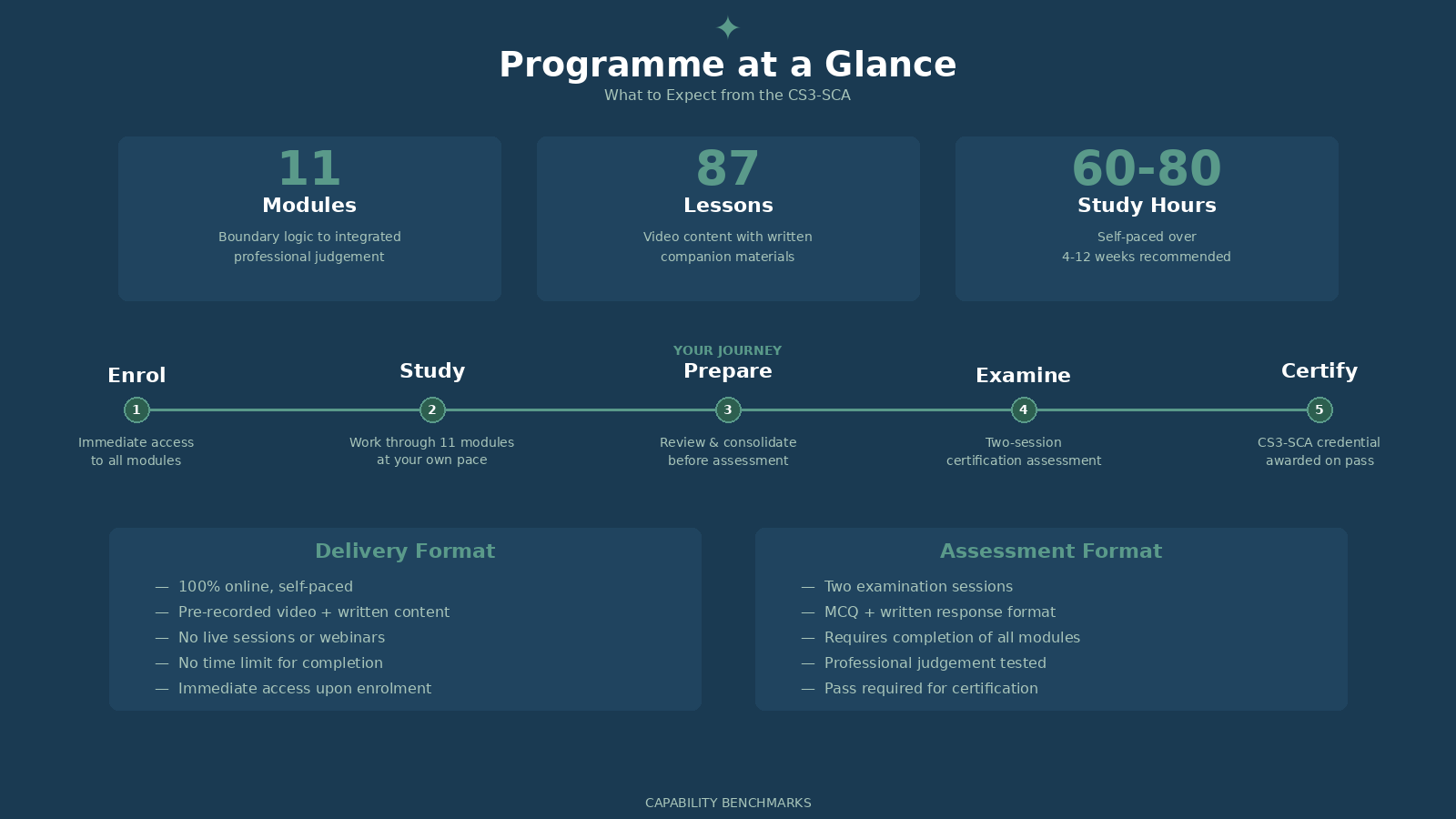
The programme is delivered entirely online through a dedicated learning environment. All content is pre-recorded and text-based; there are no live sessions, webinars, or scheduled components. Access is immediate upon enrolment. Candidates may progress through modules at their own pace. There is no time limit for programme completion, though access to the certification assessment requires completion of all modules.


The programme was designed for self-directed study by experienced professionals. There is no immediate instructor support, no tutoring, or mentorship. Candidates are expected to engage with the material independently.

Study commitment

Expected Commitment

The programme contains approximately 40 hours of instructional content across 11 modules. Candidates should expect total study time of sixty to eighty hours including content review, note-taking, and assessment preparation.

The programme is designed for completion over four to twelve weeks, though candidates may take longer if circumstances require. Attempting to complete the programme in less than three weeks is not recommended.
Ready to Review Assessment Details?

Understand the certification assessment format, requirements, and what certification represents.

Assessment